
GEO vs SEO: What's the Difference (and Do You Need Both)?
May 8, 2026 • 10 Min Read
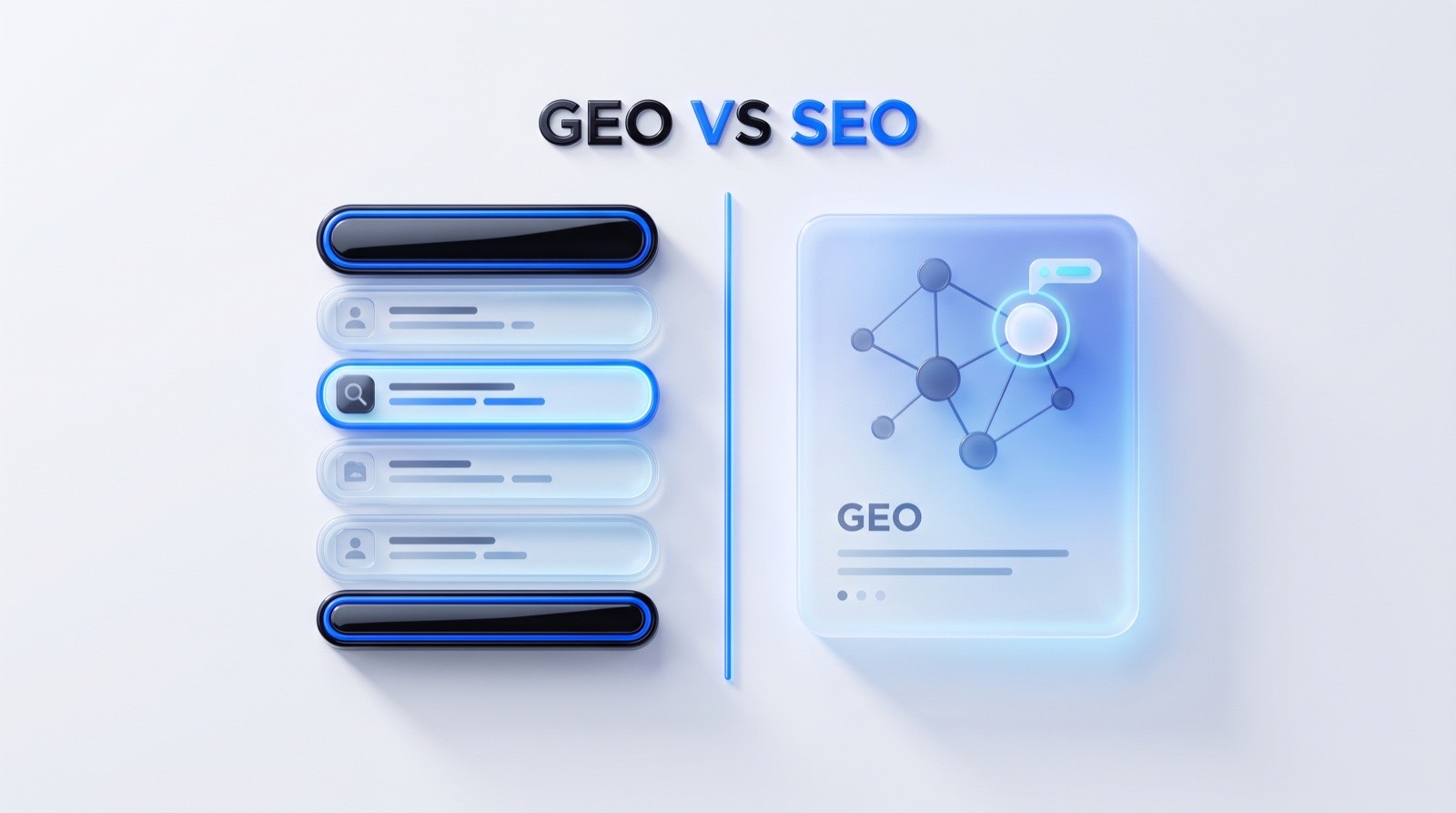
If you've spent any time in marketing circles lately, you've probably watched the same small argument play out: someone declares that GEO is the future, someone else rolls their eyes and says it's just SEO wearing a new hat, and the conversation ends without anyone actually defining the difference. So let's define it.
SEO optimizes to be ranked in a list of links. GEO optimizes to be cited inside an AI-generated answer - the kind ChatGPT, Perplexity, Gemini, or Google's AI Overviews produce. They share most of their plumbing: crawlability, authority, content quality. But they aim at different outcomes and are judged by different numbers. The honest bottom line, which we'll defend below, is that this isn't an either/or. You need both, and the good news is they reinforce each other more than they compete.
Here's the whole thing at a glance, and then we'll unpack it.
GEO vs SEO at a glance
| SEO | GEO | |
|---|---|---|
| Goal | Rank in search results | Be cited in AI answers |
| Where it plays | Search engine results pages | Generative engines & AI answer boxes |
| What you optimize | Keywords, backlinks, on-page relevance | Entity clarity, structured facts, citable passages |
| Primary success metric | Rankings, organic clicks, traffic | Share of voice, citations, mentions |
| Key signal | Links and ranking authority | Authority + machine-readable structure |
| What the user sees | A list of links to choose from | A synthesized answer, with a few sources named |
| Typical payoff | A click to your site | A mention that shapes the decision (often click-free) |
Notice that most of the inputs rhyme even though the outputs differ. That's the tension the rest of this piece resolves.
SEO and GEO, in one line each
You likely know SEO: you make pages that search engines rank well, so people find and click them. The whole machine is built around earning and converting that click.
GEO is the younger sibling. Instead of competing for a position in a list, you're trying to be one of the handful of sources an AI engine leans on when it writes an answer. The term comes from a 2023 research paper, "GEO: Generative Engine Optimization," published at KDD 2024 - if you want the fuller story, we wrote a complete guide to what GEO is. For this comparison, one line is enough: GEO is optimizing to be the source behind the answer, not the link beside it.
Where GEO and SEO actually diverge
The differences that matter aren't cosmetic. There are five.
Citations replace clicks and links. In SEO, a backlink is currency and a click is the prize. A generative engine doesn't care about your backlink profile the way a ranking algorithm does, and it frequently answers the user without sending a click at all. The "win" becomes being named as a source - a mention that influences the reader even when no one visits your page.
Entities and structure beat keywords and link equity. Ranking algorithms grew up on keywords and links. Generative engines lean harder on whether they can confidently understand what your page is about and who you are - which is why entity clarity and structured data carry more weight here than they ever did for classic ranking.
There's no page two. A results page has ten organic slots, ads, and a scroll. An answer names two or three sources. The distribution of attention is brutally top-heavy: you're in the answer or you're nowhere for that question. SEO has always had a long tail of "good enough" positions; GEO mostly doesn't.
One query becomes many. Generative engines often break a single question into several sub-questions and assemble an answer from all of them. You're not optimizing for one keyword anymore; you're trying to be useful across a small cluster of related intents at once.
Success is measured differently. Rankings and sessions don't capture whether you were mentioned in an answer, how you were framed, or how your share of those answers compares to a competitor's. That requires a different kind of measurement, which we'll get to.
What stays the same (the part most comparisons skip)
Read enough "GEO vs SEO" content and you'd think the two share nothing. They share a great deal - and pretending otherwise leads people to throw away work that's actually helping them.
Generative engines still need to crawl and read your pages. They still favor content that's genuinely useful, accurate, and well-organized. They still lean on the signals that establish expertise and trust. Google has been blunt about this in its own documentation, framing its AI features as "rooted in our core Search ranking and quality systems" - which is a polite way of saying the fundamentals didn't change.
The practical implication is reassuring: a well-run SEO program is a head start on GEO, not wasted effort. If your site is technically sound, authoritative, and clearly written, you've already done much of the hard part. GEO mostly asks you to add a layer - structured data, citable formatting, presence beyond your own domain - on top of a foundation you may already have.
Do you need both? How to split your effort
Yes, you need both, and the reason is simple arithmetic of attention. Traditional search still drives enormous volume and still rewards you with clicks you control. AI answers are where a growing slice of discovery now starts, and they build authority even without a click. Optimizing for one and ignoring the other means leaving half the field empty.
A sane way to divide effort, without hiring a second team:
- Keep the SEO foundation funded. It feeds both worlds. Technical health, quality content, and authority are not "old" work - they're shared infrastructure.
- Add the GEO-specific layer deliberately. Structured data, answer-first formatting, and off-site presence are the additions that turn an SEO-strong page into a GEO-strong one.
- Decide who owns what. GEO doesn't sit neatly in one department - it touches content (citable writing), technical (structured data, crawler access), and PR (off-site mentions). Naming an owner for each is worth more than buying another tool.
You're not really choosing between two strategies. You're running one strategy with a new surface to win on.
How to measure GEO vs SEO
Because the goals differ, the dashboards differ.
For SEO you already know the vocabulary: rankings, organic clicks, impressions, click-through rate. These map cleanly to traffic and conversions, and your existing tools report them.
For GEO the meaningful numbers are about presence in answers:
- Share of voice - across a fixed set of questions, how much of the answer "airtime" belongs to you versus competitors.
- Citation frequency - how often your domain is named as a source.
- Sentiment - when you're mentioned, is the framing accurate and favorable.
- AI search volume - how much demand for a topic lives inside AI engines, which can diverge from classic keyword volume.
A useful habit: pick a stable set of real customer questions, check them on a regular cadence, and watch the trend rather than any single result. Generative answers are volatile - independent analyses have found that a large share of the sources an engine cites can change from one month to the next - so a single snapshot tells you almost nothing, while a trend tells you everything.
At the page level, a GEO Score (a 0-100 readiness grade) gives you something concrete to improve, the way a Lighthouse score does for performance.
How to do both without doubling the work
The fear behind the "GEO vs SEO" debate is usually workload: nobody wants to run two full programs. You don't have to, because the foundation does double duty.
Most of what makes a page rank - clear writing, real expertise, technical soundness, internal links - also makes it citable. The GEO-specific additions are comparatively small and mostly structural: marking up your entities with valid structured data, leading sections with a direct answer, making sure AI crawlers can reach you, and earning credible mentions elsewhere.
This is exactly the gap GeoGenie is built to close. Rather than reporting that you're invisible and leaving you to figure out the rest, our SiteGenie module audits a page, scores it, and generates the actual fixes - validated structured data ready to paste into your site, internal-linking suggestions, and an index check across multiple engines to confirm the foundation is in place. The shared work between SEO and GEO is precisely the work it automates.
If you want a fast read on where a page stands across both worlds, run a free AI visibility report and see what AI engines understand about it today.
Frequently asked questions
Will GEO replace SEO?
No. The evidence points to coexistence, not replacement. Even the prediction that traditional search volume will shrink describes a shift, not a death - and generative engines depend on the same crawlable, authoritative web that SEO builds. Treat GEO as an evolution layered on top of search, and be skeptical of anyone announcing SEO's funeral.
Is GEO harder than SEO?
Not harder, just different - and in some ways easier right now, because the field is less crowded. Most of the work overlaps with good SEO. The genuinely new parts (structured data, citable formatting, off-site signals) are learnable, and competition for them is currently lighter than the years-long battles for competitive keywords.
Can the same page rank #1 on Google and get cited by ChatGPT?
Often, yes. Clear, well-structured, authoritative content tends to do both, because the underlying signals overlap so much. It's worth deliberately adding the formatting that makes a page easy to quote - self-contained answers, specific stats, credible sources - but you're enhancing one asset, not building two.
Do I need separate tools for GEO and SEO?
You'll want GEO-specific measurement that a rank tracker simply can't give you - share of voice in answers, citation frequency, sentiment. But the technical fixes (structured data, indexing, internal links) live in the same place as your SEO work, which is why it makes sense to handle measurement and fixing together rather than bolting on yet another dashboard.
Is GEO worth it if most AI answers don't produce a click?
Yes - zero-click doesn't mean zero-value. Being the cited source builds authority and brand recall that shapes the eventual decision, even when no one visits your site in that moment. The right thing to measure is mentions and citations, not just sessions; judging GEO by click volume is judging it by the wrong scoreboard.
The "GEO vs SEO" framing makes it sound like a fight. It isn't. It's one discipline with an old surface (the results page) and a new one (the answer), built on the same foundation and won by the same qualities: clarity, credibility, and proof. Build the foundation once, then make it legible to the machines now writing the answers.
See how a page performs across both: run a free AI visibility report.