
The Scale Layer: One Page Per Query, Not One Page Per Topic
July 2, 2026 • 6 Min Read
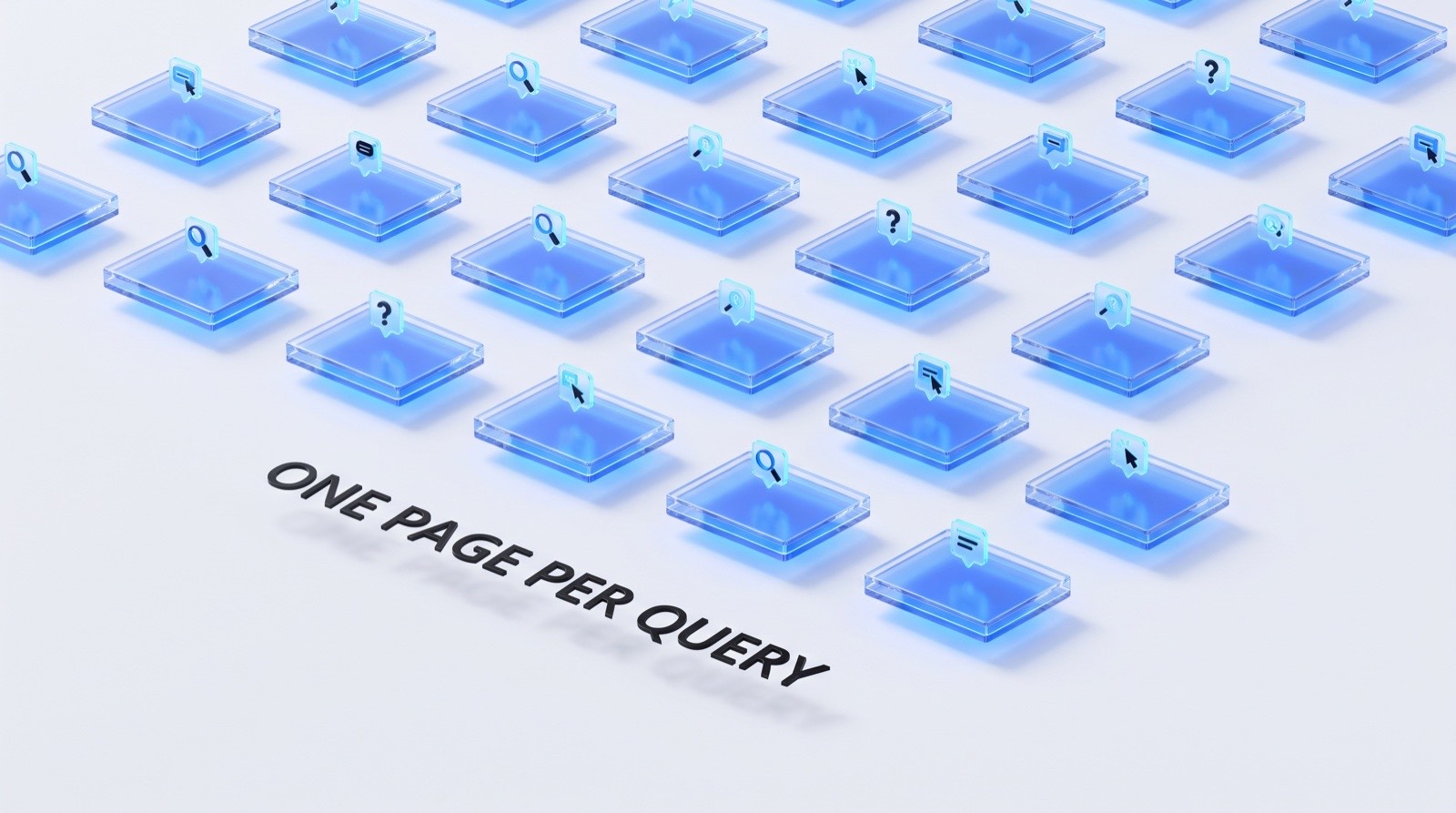
For two decades, content architecture had one rule: build the definitive page on a topic. Consolidate everything about "running shoes" onto one comprehensive, authoritative URL, earn its links, and rank it. That rule built the modern web - and AI search is quietly inverting it.
The new rule for AI visibility is the opposite: one page per query, not one page per topic. Where SEO rewarded consolidation, AI rewards specificity, because of how AI answers get built. Engines don't rank your big page; they lift a clean, self-contained passage that answers one specific question. A sprawling topic page is hard to lift from. Ten focused query pages are ten clean answers - and they cover ten distinct questions instead of one. That shift is what we call the Scale Layer, and this guide is how to build it.
(It's the second layer of the brand-GEO framework - see Trust / Scale / Signal for the full stack. This piece is the practical "how.")
Why one-page-per-topic fails for AI
Picture a single 4,000-word page covering everything about a category. For Google, that page is an asset: comprehensive, link-worthy, rankable. For an AI engine assembling an answer to a specific question, it's a problem:
- The relevant answer is buried somewhere in 4,000 words, hard to isolate.
- The page tries to serve a dozen different intents at once, so no single passage is the clean, complete answer to any one of them.
- It covers one query-cluster well and a dozen adjacent queries poorly - when each of those adjacent queries could have been its own precise, citable page.
The very consolidation that made the page strong for ranking makes it weak for citation. AI doesn't want your encyclopedia entry; it wants the one paragraph that answers the question, and it would rather get it from a page built to be exactly that.
What a "query page" looks like
A Scale-Layer page is built around a single real question and engineered to be the cleanest answer to it:
- One question, fully answered. The page exists to answer one specific query ("how do I [specific thing] for [specific situation]"), completely, without padding.
- Answer-first. It leads with a direct, self-contained answer in the first sentence or two, before context and nuance. (See answer-first content.)
- Self-contained and extractable. A machine can lift the core answer as a clean chunk without needing the rest of the page.
- Specific and structured. Real numbers, named specifics, tables where they fit, and valid structured data - the things that make a passage safe to quote.
The test for any query page: could an engine copy the answer block and drop it into a response, correct and complete, with nothing else from the page? If yes, you've built a Scale-Layer page. If it only makes sense in the context of a broader article, it's still a topic page in disguise.
How to build the Scale Layer (in practice)
1. Find your real queries. Start from the actual questions your buyers ask AI - your Coverage and especially your high-intent Depth queries (see Coverage vs Depth prompts). These are your page candidates. Don't invent them; harvest them from real buyer intent.
2. Decide what gets its own page. Not every query needs a standalone page, and over-splitting creates thin content. The rule of thumb: a query earns its own page when it has distinct intent and enough substance to answer fully and uniquely. If two "queries" would produce nearly identical pages, they're one page. If a section of a big page is really answering a separate question people ask on its own, promote it to its own page.
3. Build each as a clean, single-answer page. Answer-first, self-contained, specific, structured. One question in, one citable answer out.
4. Connect the cluster. Query pages aren't islands - link them to each other and up to the relevant topic/cornerstone page, so both engines and readers can navigate the set and so the cluster reinforces its authority.
5. Avoid the thin-content trap. "One page per query" is not "one thin page per keyword variation." Each page must genuinely, fully answer a distinct question. Specificity is the point; padding is not. If a page can't say something complete and useful on its own, it shouldn't exist.
Scale without sprawl
The obvious objection: doesn't this mean hundreds of pages? It can - which is exactly why the Scale Layer is an architecture problem, not a writing-more problem, and why it pairs with execution tooling. The work isn't "produce endless content"; it's "produce the right focused pages for the queries that matter, derived from real intent, each citable by construction." That's a pipeline: identify the query, generate a brief that encodes the answer-first, structured shape, produce the page, connect it, measure it. (That insight-to-published loop is the job of ActionsGenie - see from insight to execution.)
Built deliberately, the Scale Layer turns your content from one big page AI struggles to quote into many precise pages AI is happy to cite - across every question your buyers actually ask.
The starting point is seeing how citable your current pages are. Run a free AI visibility report on a key page and find out whether it's a quotable query page or an un-liftable topic page.
Frequently asked questions
Doesn't this contradict everything SEO taught me?
It revises it. Topic pages still help with ranking and authority; the Scale Layer adds focused query pages built for AI citation. You're not tearing down your topic pages - you're adding a layer of specific, citable pages around the questions that matter.
Won't one page per query create thin content?
Only if you do it lazily. A query page must fully and uniquely answer a distinct question - that's substantial, not thin. The failure mode is splitting near-identical keyword variations into separate pages; the goal is distinct questions, each answered completely.
How do I know which queries deserve their own page?
Real, distinct buyer intent plus enough substance to answer uniquely. Harvest the queries from actual buyer questions (your Coverage/Depth prompts), then give standalone pages to the high-intent ones with their own clear answer.
How does this relate to internal linking?
Tightly. Query pages should link to each other and up to a parent topic page, so the cluster is navigable and its authority compounds. Isolated query pages underperform connected ones.
Isn't this a lot of pages to manage?
Yes - which is why it's an architecture and pipeline problem. The leverage is in deriving the pages from real intent and generating them efficiently, not in writing endlessly. Build the system, not a pile of articles.
SEO rewarded the definitive topic page; AI search rewards the focused query page, because engines cite specific passages, not comprehensive articles. The Scale Layer is the architecture that follows from that - one clean, citable answer per real question your buyers ask. Build it deliberately, connect it, and keep it specific, and you go from one page AI can't quote to many it's glad to.
See whether your page is citable: run a free AI visibility report.