
The Trust / Scale / Signal Framework for Brand GEO
June 29, 2026 • 7 Min Read
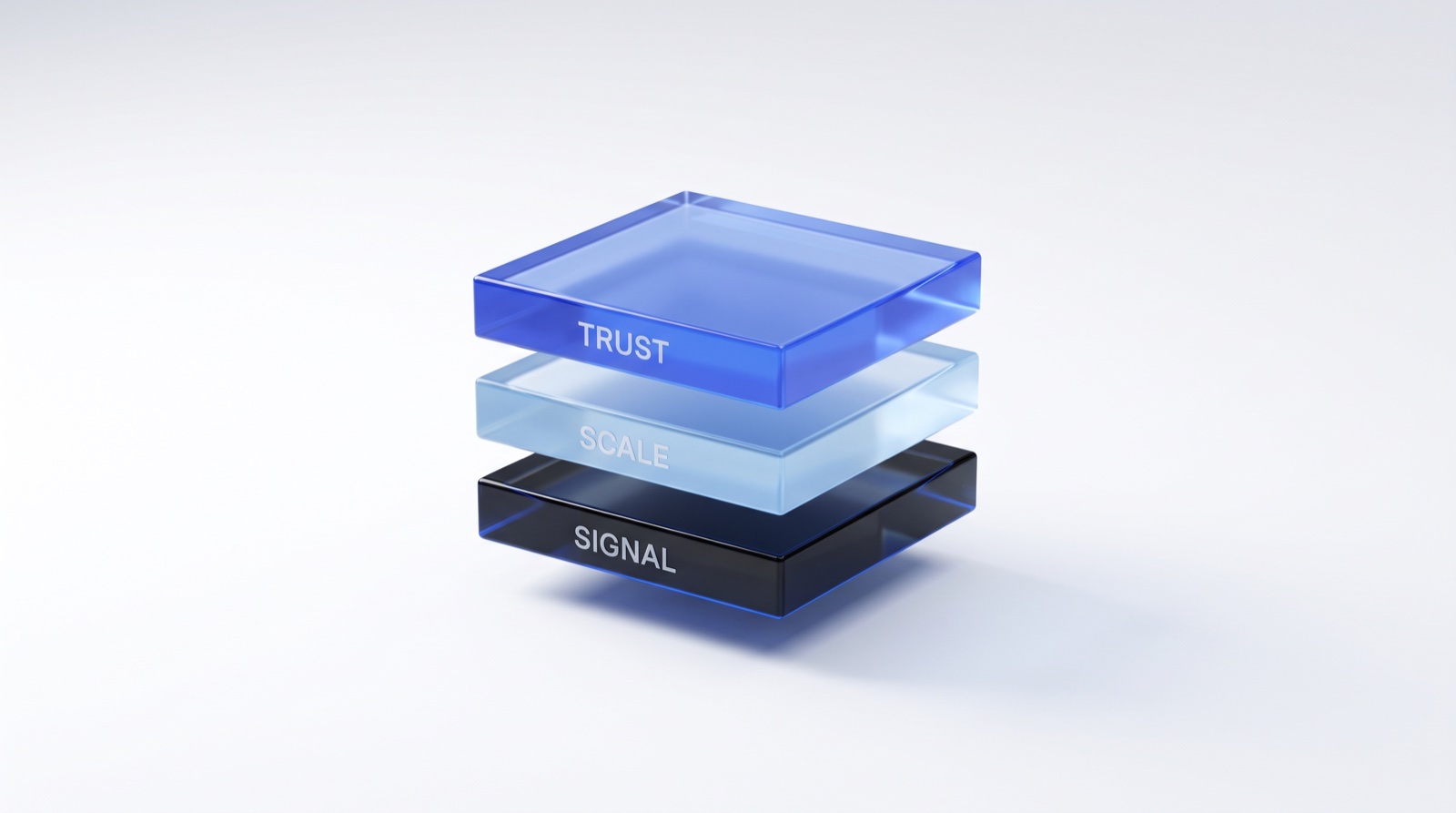
In-house brand teams ask a version of the same question: how do we control how AI describes us? The honest answer is that you don't control it - but you do shape it, and the work breaks into three layers. Get all three right and AI engines understand who you are, find you for the questions that matter, and trust you enough to recommend you. Miss one and the others can't compensate.
We call the three layers Trust, Scale, and Signal. Here's the one-line version of each:
- Trust Layer: Your own content: the authoritative source of truth about your brand.
- Scale Layer: Your content architecture: one page per query, not one page per topic.
- Signal Layer: The off-site citations and mentions that mediate everything.
Think of it as a stack. Trust is the foundation, Scale is how that foundation reaches every question, and Signal is the corroboration that makes engines believe it. Let's build each one.
Layer 1 - Trust: own your source of truth
What it is: the content you control - your site - stating clearly, accurately, and unambiguously who you are, what you do, and what's true about you. This is the canonical reference an AI engine grounds on when it describes your brand.
Why it matters: if your own house isn't in order, every downstream answer inherits the confusion. Vague positioning, missing facts, or unstructured pages leave the engine to guess - or to rely entirely on what others say about you. The Trust Layer is where you remove that ambiguity.
How to build it:
- State your core facts plainly and answer-first, so a machine can extract them without interpretation.
- Mark up your entities with valid structured data - who you are (Organization), what you offer, how it all connects - so the meaning is machine-readable, not inferred. (See structured data for AI.)
- Keep an authoritative "about / facts" surface current, so the truth is always the most available version.
The Trust Layer answers the engine's first question: can I understand, from a credible primary source, what this brand is?
Layer 2 - Scale: one page per query, not one page per topic
What it is: the architecture of your content - and the single most counter-intuitive idea in brand GEO. In traditional SEO, you build one comprehensive page per topic. For AI search, you increasingly need one page per query - a distinct, focused answer for each specific question your buyers ask, because AI assembles answers from specific passages, not broad pages.
Why it matters: a sprawling "everything about X" page is hard for an engine to lift a clean answer from. Ten focused pages, each nailing one real question, give the engine ten precise, extractable sources - and cover ten distinct queries instead of one. Topic pages build authority; query pages get cited.
How to build it:
- Map the actual questions your buyers ask (your Coverage and Depth prompts - see Coverage vs Depth prompts).
- Give the high-intent ones their own focused, answer-first pages - each a clean, self-contained answer to one question.
- Connect them with internal links so the engine (and the reader) can navigate the cluster.
The Scale Layer answers the engine's second question: for this specific question, do they have a clean, citable answer? - across every question that matters, not just the headline one.
Layer 3 - Signal: the off-site corroboration that mediates everything
What it is: the mentions, reviews, references, and citations about your brand that live beyond your own site. These third-party signals mediate how AI weighs everything else - because an engine trusts a claim more when independent sources echo it.
Why it matters: this is the layer brand teams most often neglect, and it's frequently the deciding one. A perfect Trust Layer and a complete Scale Layer can still lose to a competitor who's simply talked about more credibly across the web. AI doesn't form its opinion of you from your site alone; it cross-checks. (This is the citation supply chain at work.)
How to build it:
- Earn genuine mentions in the reputable sources your category's AI answers actually cite.
- Maintain a consistent brand entity everywhere you appear, so engines recognize the same brand across sources.
- Be present where buyers research and compare - communities, reviews, reference works - without manufacturing it (astroturfing backfires and erodes the very authenticity that makes Signal valuable). (See off-site signals.)
The Signal Layer answers the engine's third question: do other credible sources corroborate what this brand says about itself?
Why all three, in order
The layers depend on each other:
- Trust without Scale means you're credible but absent from most of the specific questions buyers ask.
- Scale without Trust means lots of pages, none of them an authoritative source of truth.
- Trust + Scale without Signal means a great-looking brand that engines can't yet trust, because no one else vouches for it.
Build them bottom-up: get your source of truth right (Trust), extend it to every question that matters (Scale), then earn the corroboration that makes engines believe it (Signal). Skip ahead and you'll plateau.
How brand teams operationalize this
For an in-house team, the framework turns a vague mandate ("improve our AI visibility") into a clear program: audit and fix the Trust Layer, architect the Scale Layer around your real buyer questions, and build the Signal Layer where your category's answers are actually sourced. It's the structure behind GeoGenie's Brands solution - measure where each layer stands, then close the gaps.
The fastest place to start is the Trust Layer, because it's the foundation and the quickest to assess: see what AI currently understands about your most important page.
Run a free AI visibility report to check your Trust Layer, then build out from there.
Frequently asked questions
Why "one page per query" instead of one comprehensive page?
Because AI lifts specific, self-contained passages, not broad pages. Focused query pages give engines clean, extractable answers and let you cover many distinct questions - where a single sprawling topic page covers one and extracts poorly.
Which layer should a brand team fix first?
Trust - it's the foundation, and the others inherit its accuracy. Get your own source of truth clear and machine-readable, then scale it across questions, then build off-site corroboration.
Isn't the Signal Layer outside my control?
You influence it, you don't control it - and that's true of all of AI visibility. You earn corroboration over time through genuine mentions and consistent identity; you can't (and shouldn't try to) manufacture it.
How is this different from SEO?
The Trust and Signal layers rhyme with SEO fundamentals (authority, mentions). The Scale Layer is the genuinely different idea - architecting one page per query for extraction, rather than one page per topic for ranking.
How do I measure progress across the three layers?
Track your AI visibility metrics (Visibility %, Share of Voice, Citation Rate) and watch which questions you win as you strengthen each layer. Improvement in citations, especially, signals the stack is working.
Controlling how AI describes your brand is really three jobs: own your source of truth (Trust), extend it to every question that matters (Scale), and earn the corroboration that makes engines believe it (Signal). Build the stack bottom-up, and "how do we shape what AI says about us?" becomes a program you can actually run.
Start with your Trust Layer: run a free AI visibility report.