
Visibility %, Share of Voice & Citation Rate: The 3 Metrics of AI Search
May 18, 2026 • 8 Min Read
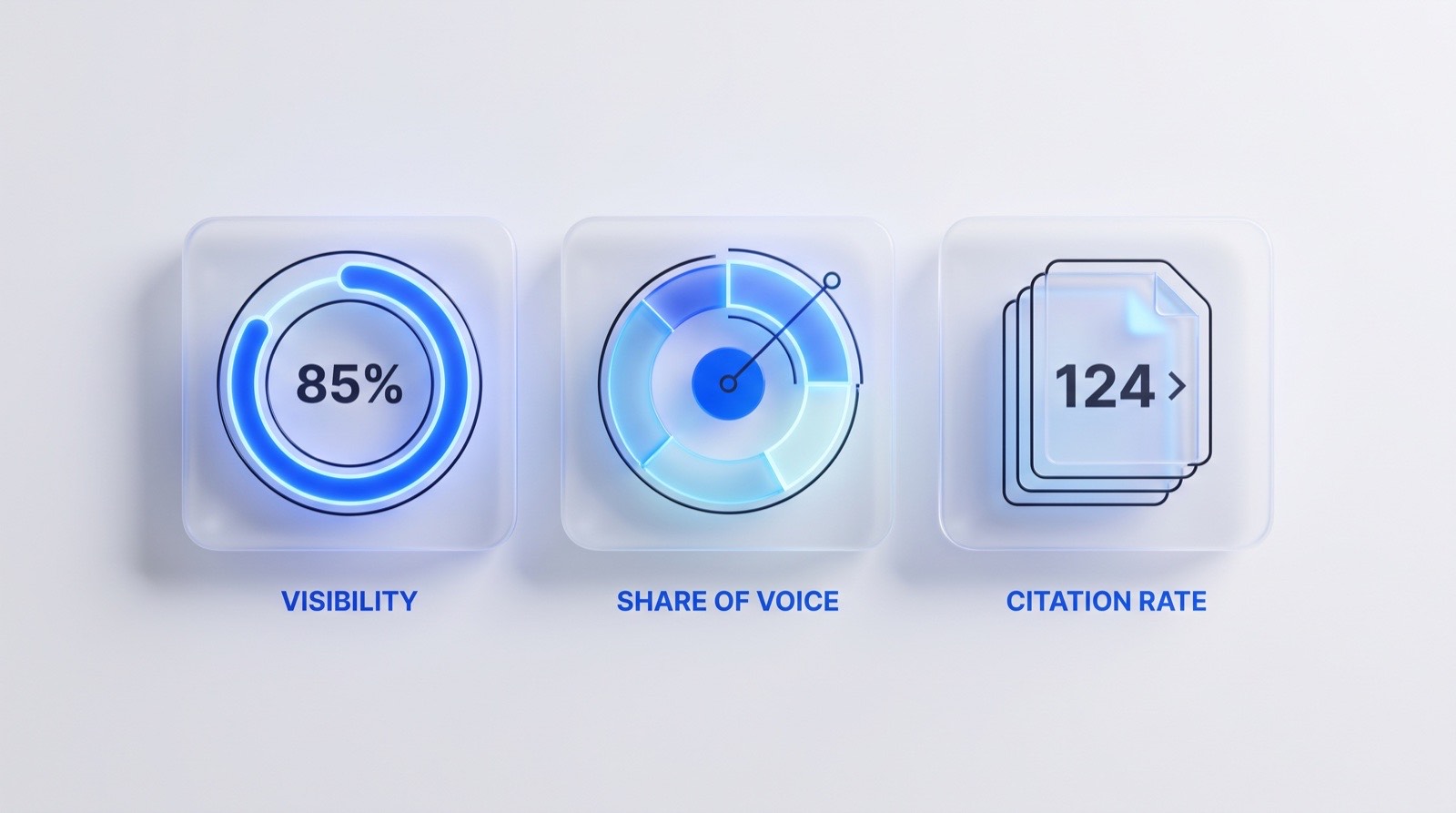
Rankings and clicks ran a generation of SEO. They don't work for AI search, because an AI answer rarely produces a ranking position or a click - it produces a mention, or it doesn't. So if you want to manage your AI visibility, you need a different scoreboard. Three metrics make up that scoreboard: Visibility %, Share of Voice, and Citation Rate. Each answers a different question, and you need all three to see the full picture.
Here's the one-line version of each before we go deep:
- Visibility % - how often do you show up at all? The share of your tracked questions where your brand appears in the AI answer.
- Share of Voice - how much of the conversation is yours? Your presence relative to competitors across those answers.
- Citation Rate - how often are you the source, not just a mention? The share of answers that actually cite your domain as a reference.
Track one in isolation and you'll draw the wrong conclusion. Track all three and you know exactly where you stand and what to fix. Let's take them one at a time.
Visibility % - are you in the answer?
What it measures: across a defined set of questions (your tracked prompts), the percentage where your brand appears in the AI-generated answer at all.
How to calculate it: Visibility % = (prompts where your brand appears ÷ total prompts tracked) × 100. If you track 100 buyer questions and you're named in 18 of the answers, your Visibility % is 18%.
Why it matters: it's your presence baseline - the broadest measure of "are we even in the conversation?" A brand at 0% Visibility is invisible; that's a more common starting point than most teams expect.
How to read it: the absolute number matters less than the trend and the which. Rising Visibility % means your AI presence is growing. But always pair it with which prompts - being visible on low-value questions and absent on the high-intent ones is a worse position than the headline number suggests. Which is why prompt selection (broad Coverage questions vs high-intent Depth questions) shapes what Visibility % even means.
The common mistake: treating Visibility % as the whole story. Appearing in an answer isn't the same as being recommended, and it isn't the same as being the cited source. It's necessary, not sufficient.
Share of Voice - how much of the conversation is yours?
What it measures: your presence in AI answers relative to your competitors. Where Visibility % asks "are we there?", Share of Voice asks "how much of the airtime is ours versus everyone else's?"
How to calculate it: across your tracked prompts, count how often each brand (you and your competitors) appears, then Your SoV = (your appearances ÷ total brand appearances across all tracked brands) × 100. If, across your prompt set, brands are named 200 times total and you account for 24 of them, your Share of Voice is 12%.
Why it matters: AI answers are zero-sum in a way a results page isn't - an answer names a few brands, and every slot a competitor takes is one you didn't. Share of Voice is the competitive truth that Visibility % hides. You can have a "decent" Visibility % and still be losing badly if a competitor is named in nearly every answer you appear in.
How to read it: watch your SoV against the leaders in your category over time. A category where one incumbent holds a dominant Share of Voice is one where you'll need to win the questions they don't own - often the technical, how-to, and "fix it" questions where no brand has staked a claim yet - rather than fighting head-on for the crowded ones.
The common mistake: measuring your own visibility in a vacuum. Without the competitive denominator, you can't tell whether a rising Visibility % means you're winning or just rising with the tide while competitors rise faster.
Citation Rate - are you the source, or just a name?
What it measures: the share of answers where your domain is actually cited as a source - linked or attributed as where the information came from - not merely mentioned in passing.
How to calculate it: Citation Rate = (prompts where your domain is cited as a source ÷ total prompts tracked) × 100. Being named ("brands like yours…") is weaker than being cited (the engine pulls from your page and attributes it).
Why it matters: citation is the deepest, most durable form of AI visibility. A mention can be generic; a citation means the engine treated your content as the authority for that answer. Citations also tend to be stickier and more defensible than mentions, and they're the clearest evidence that your citation supply chain (see what is the citation supply chain) is working.
How to read it: Citation Rate is usually your lowest of the three numbers, and that's expected - being the cited source is harder than being mentioned. Treat improvements here as your highest-quality wins. A rising Citation Rate means your own content is becoming the reference, not just a name the model recalls.
The common mistake: conflating mentions with citations. They're different signals with different value; a tool (or a report) that blurs them overstates your real authority.
Why you need all three together
Each metric corrects the others' blind spots:
- Visibility % without Share of Voice hides whether you're winning or losing the competitive race.
- Share of Voice without Citation Rate can't tell a passing mention from being the trusted source.
- Citation Rate without Visibility % misses how much of the category you're absent from entirely.
Read together, they tell a clear story: Visibility % says how much of the conversation you're in, Share of Voice says how you stack up in it, and Citation Rate says how often you're the authority behind it. That's a scoreboard you can actually manage - and it's exactly the trio our MonitoringGenie module tracks across ChatGPT, Perplexity, Claude, Gemini, and Google AI Overviews, prompt by prompt.
How to start measuring
You don't need a tool to grasp the idea - you need a stable, representative set of the questions your buyers actually ask, run consistently across the engines, with the three metrics recorded each time. The discipline is in keeping the prompt set fixed (so the trend is real) and watching all three numbers move together. Manual spot-checks won't scale past a handful of questions, which is the point at which continuous tracking earns its keep.
To anchor the measurement side, see how to measure AI search visibility for the broader framework, and explore MonitoringGenie for tracking the three metrics continuously.
Frequently asked questions
What's the difference between a mention and a citation?
A mention is your brand named in an answer; a citation is the engine attributing information to your domain as a source. Citation is the stronger, more durable signal - it means your content was the authority, not just a name the model recalled.
Which metric should I optimize for first?
Visibility % first (you can't have Share of Voice or Citations if you never appear), then Share of Voice to find where you can realistically win, then Citation Rate as your highest-quality target. They build on each other.
How often should these be measured?
On a regular cadence with a fixed prompt set - AI answers shift, so a single snapshot tells you little while a trend tells you everything. Monthly is a reasonable baseline; more frequent for fast-moving categories.
Can I track these for competitors too?
Yes - and you should, because Share of Voice is meaningless without the competitive denominator. Tracking the same prompt set across you and your rivals is what turns "are we visible?" into "are we winning?"
Why is my Citation Rate so much lower than my Visibility %?
That's normal. Being mentioned is easier than being the cited source. A low Citation Rate relative to Visibility % usually means your own content isn't yet authoritative or extractable enough to be the reference - which is a content and structured-data problem you can fix.
AI search rewrote the scoreboard. Visibility % tells you how often you show up, Share of Voice tells you how you compare, and Citation Rate tells you how often you're the source. Watch one and you'll misread your position; watch all three and you'll know exactly where you stand - and which questions to go win next.
See where you stand today: run a free AI visibility report.